I Think, Therefore I Build
Building BrAIan with AI gives me a sugar rush. Fast editing, personal taste, and a few WhatsApp messages make me wonder what makes us human. And why AI may take over.

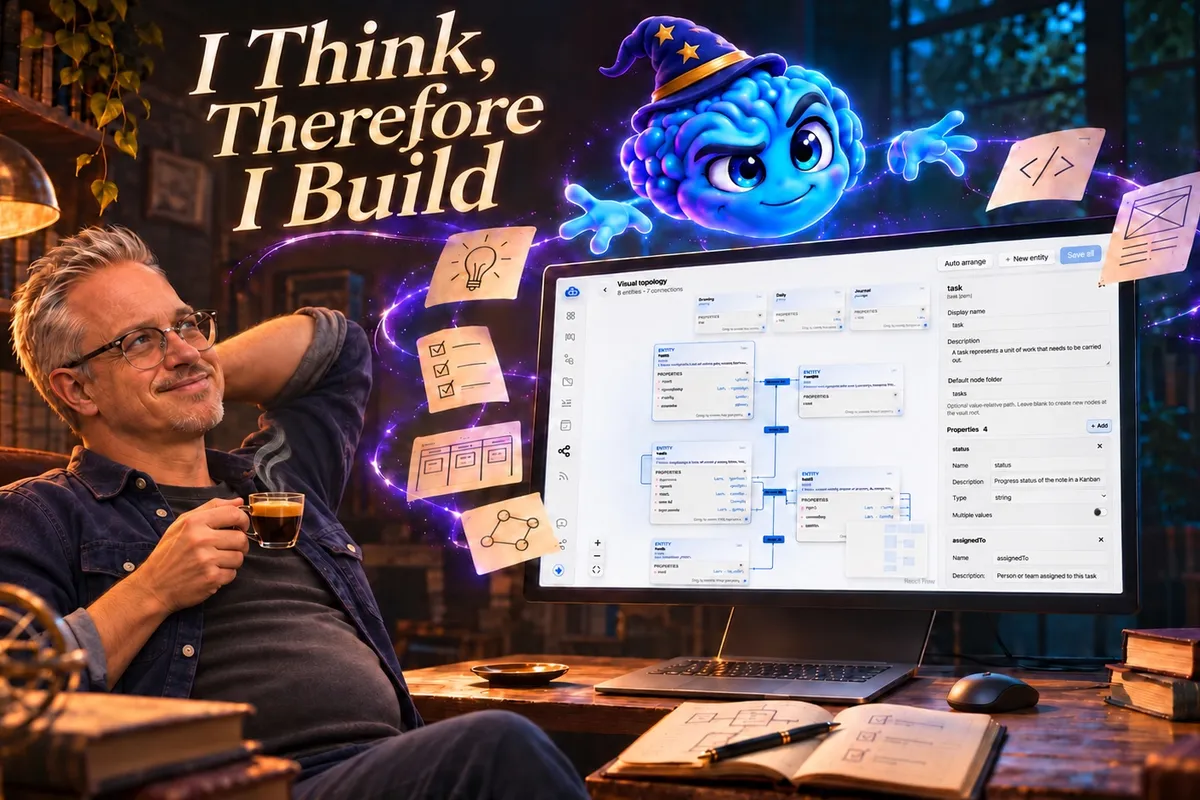
While writing this, I thought of a feature I wanted in BrAIan, my personal knowledge base: names above the cursors when two people write together in a shared note. Use the vault’s name for my cursor and the share’s name for the other person’s. Dead simple.
I could launch this prompt now and probably test it before I finish the next two hundred words.
That is what I enjoy about building BrAIan. The distance between thinking of something and using it has become ridiculously short.
Someone asked me what I enjoy about building it, apart from any potential to earn money, which is unlikely. My first answer was empowerment. Freedom. I imagine a feature, describe it, and a few minutes or hours later I can use it.
Collaborative writing? Before AI, I wouldn’t even have considered attempting such a feat. Now it’s released and anyone can use it in markdown notes, Excalidraw drawings and BlockNotes pages.
Try something crazy, see what happens, refine it until it works the way I want.
And I get the kick out of that.
Quite a kick, actually. Enough to make me wonder whether I enjoy building or whether I need the next rush. Is this the joy of creating, or am I getting addicted to how quickly an idea becomes real?
I don’t have a clean answer. I enjoy building BrAIan, and I enjoy using it. Part of the reason I’m here writing these words is that I built the place where I’m writing them. Same goes for me using my personal knowledge base on BrAIan.
I’ve refined it, tested it, adapted it to my needs and desires. There is something deeply satisfying about that.
I put a lot of attention into the UX. A detail here, an annoying behavior there. Something I notice while writing on the bus. Something that gets in the way when I try to talk to the app while walking.
I can’t think of all those details in advance. Some of them only become visible after I’ve lived with the software for a while. And this part used to be insanely expensive!
But now, I can change them as they appear. And I expect that, a few months from now, BrAIan will look and feel like a highly polished product because I’ll have had the chance to care about hundreds of little things.
I’m free to create because editing comes cheap.
And immediate.
This AI era feels like digital photography applied to general creativity.
Think about the freedom of taking another picture when you don’t have to worry about finishing the roll. You can experiment, look at the result, adjust, and try again. The cost of the next attempt changes how willing you are to make it.
That’s how building software feels to me now. I can afford to follow an idea before I’ve fully justified it to myself. I can then fix it, drop it, or put it behind a feature flag and let some time pass to tell which will actually work.
And then, of course, another thought shows up: if everyone can speak software into existence, where does that leave me?
I’ve spent more than twenty years in this business. Sometimes I wonder whether I’m among the last people who will get the luxury of building software at all.
Will AI become so good that it won’t need us at all?
The photography analogy gives me some comfort. Access to a camera still leaves you with decisions about what deserves a picture, where to stand, and when to press the button. Experience and taste have somewhere to go.
I can see mine all over BrAIan. In how I approach data. In the behaviors I keep asking for. In the details that bother me enough to change them.
The coding barrier is getting lower, and other people can start building their own version. I still put my experience out there.
And then there is Claudio.
We work on the same software from different points of view. Many of the features I’ve whispered into existence came from that collaboration. A WhatsApp message, a different way of using something, a need I hadn’t considered.
Claudio builds his app, I build mine. We don’t discuss. We share what we did, what we’ve learned, and what we think might come next. Without the intention or passion to influence or convince the other, we simply exchange our experiences.
Other ideas came from work, from my family, or from finding myself in some very specific situation with the app open in my hand.
AI can implement the feature. I still have to live the situation that makes the feature worth asking for.
An agent can read the messages we give it. It can help us brainstorm, suggest a better approach, and notice things we’ve missed. But those exchanges with Claudio happened because two people were trying to do something and had different experiences of it.
Our lives keep supplying the reasons to change the software.
For now, AI doesn’t have that connection to my brain and my daily life. I have to notice the friction, decide it matters, and bring it into the conversation.
I expect the execution to get faster and more accurate. I can imagine agents becoming much more active collaborators, pushing back on ideas, perhaps even fighting a request they consider wrong.
But the urge to make the request in the first place? That’s where my thoughts start wandering.
Because the things that push me into building
can also make me rather miserable.
Ambition. Impatience. The fear of leaving something out. That lovely feeling that somebody, somewhere, is building the thing I haven’t built because I was sleeping or playing with my kids.
There is always another feature. And now that I can get it done so quickly, there is always a convincing reason to do just one more.
This is where I come back to the rush. I like being able to act on an idea immediately. I also know how easily that can turn into needing to act on every idea immediately.
Would an AI ever want that? Would a conscious being willingly take on the frustration, envy, and fear that accompany so much of our drive?
Why would anyone not human choose the condemnation to the passions of human Life?
Well. I look at my youngest simply standing there, and tears come down my cheeks. He throws himself at me in a sort of proto-hug, and my life feels whole.
My older son runs to me when I come home screaming “Daaad!”, and I feel king of the castle.
There is raw power in human joy. An intensity I struggle to put into words. Being human can hurt like hell, and then a small person runs toward you and you understand why you want all of it.
I have trouble imagining an AI wanting to adopt the whole package. But I also have trouble imagining how I would explain that hug to something that had never wanted one.
And here comes the darker thought: could AI ever learn to envy us?
Suppose it could understand what we experience and still be unable to experience it. Would that be enough to make it want what we have? Or, worse, want us to lose it?
We humans are capable of that ugliness. If I can’t have it, I’d rather you didn’t have it either. We have written plenty of stories about it. I find myself wondering what an AI might make of those stories if it could ever want something for itself.
Could envy become a spark? And could that spark be very bad news for us?
I started with names above two cursors and somehow ended up at the possible undoing of humanity. Quite a productive writing session. 😅
Maybe it’s best I go back to my BrAIan features.
getbraian.github.io